
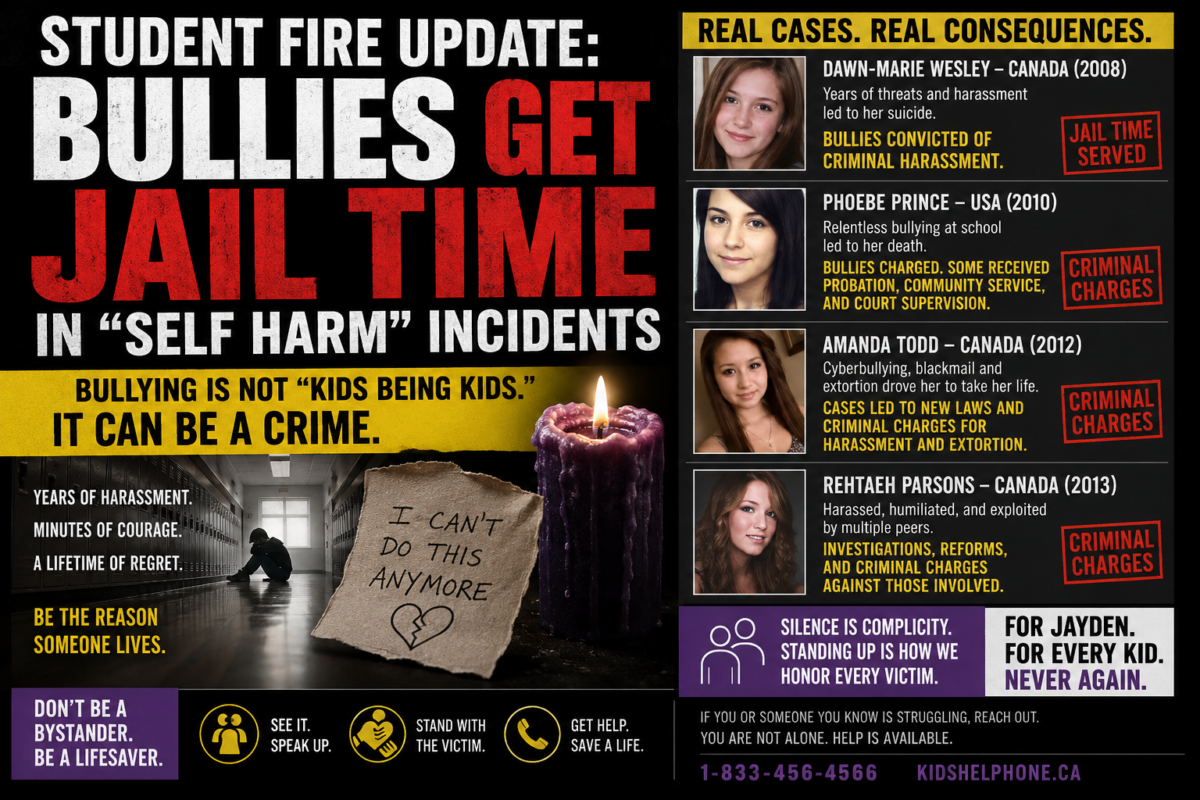
(Wingham, North Huron) Public outrage continues after the Ontario Provincial Police confirmed no charges are currently being laid in the horrific incident involving a student severely burned at F.E. Madill Secondary School.

Community members are asking how an investigation can be considered complete while the victim reportedly remains unable to fully speak for himself.
Critics argue that even if no criminal act directly caused the fire itself, years of alleged bullying, humiliation, coercion, harassment, and social isolation may still carry legal consequences.
Across Canada and the United States, courts have increasingly recognized that relentless bullying is not merely “drama” or “kids being kids.” In many cases, it has crossed into:
- criminal harassment,
- uttering threats,
- extortion,
- counselling self-harm,
- negligence,
- and civil liability.

One of Canada’s most famous precedents is the Suicide of Dawn-Marie Wesley, where teen bullies were criminally convicted after years of threats and harassment preceded a young girl’s suicide.
The deaths of Amanda Todd and Rehtaeh Parsons also changed Canadian law and public understanding of psychological abuse.
In the United States, the Suicide of Phoebe Prince led to criminal charges and sweeping anti-bullying reforms after sustained harassment at school.
Legal experts increasingly warn that bullying can create foreseeable harm, especially when:
- the abuse is prolonged,
- adults allegedly fail to intervene,
- warning signs are ignored,
- or vulnerable youth are isolated and targeted.
Parents and students in Wingham say the deeper issue is that nothing substantial appears to have changed.
“The conditions still exist,” said one concerned parent. “That should terrify everyone.”
Students continue to describe a culture where bullying is normalized, ignored, minimized, or treated as entertainment until tragedy strikes.
Advocates are now calling for:
- independent review,
- stronger anti-bullying enforcement,
- counselling supports,
- anonymous reporting systems,
- and a student-led movement encouraging youth to stand beside victims instead of remaining silent bystanders.
Because many believe the real question is no longer simply:
“Who lit the fire?”
But also:
“What culture allowed a child to reach that point?”