
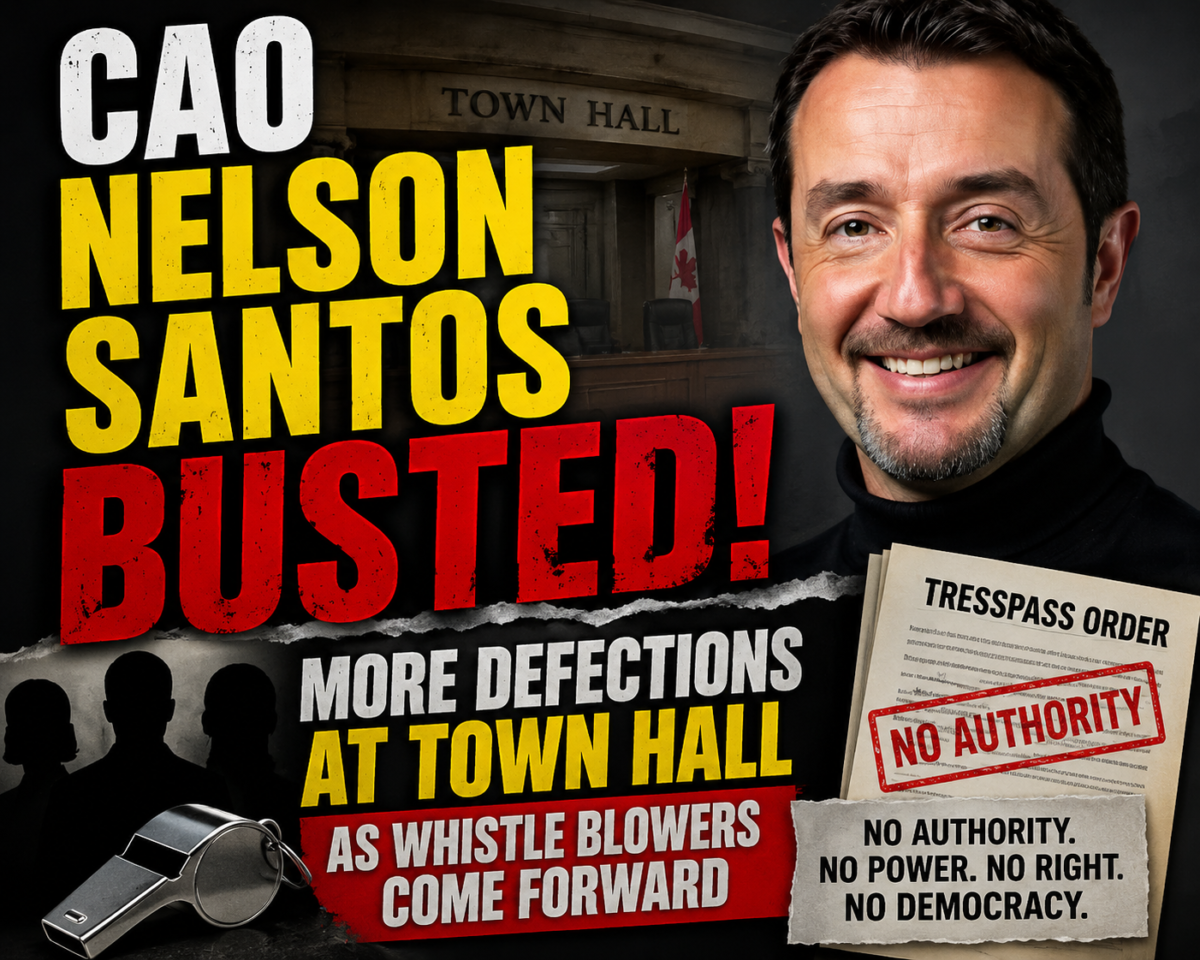
(Wingham, North Huron) Democracy in Canada does not belong to a CAO. It does not belong to a clerk, a police officer, or a politician. Council chambers are supposed to be a sacred democratic space where the public can observe, question, criticize, and hold elected officials accountable. That right does not disappear because a municipal employee becomes uncomfortable with scrutiny, cameras, or tough questions.

Yet in North Huron, residents say that is exactly what happened.
For months, controversy has surrounded the actions of North Huron CAO Nelson Santos after he issued trespass notices and effectively banned members of the public and press from council chambers. Critics argue Santos never had the legal authority to do so in the first place, and that the entire situation represents one of the most dangerous examples of administrative overreach seen in recent local politics.
At the heart of the issue is a simple legal question:

Who actually has authority over council chambers during a council meeting?
CAO Authority Abuse BUSTED!
Under Ontario’s Trespass to Property Act, trespass notices can only be issued by an “occupier” of the premises or someone authorized by the occupier. During council meetings, the occupier is arguably council itself — not an unelected employee acting alone. In practical terms, that means authority would need to be explicitly delegated by council through a bylaw, resolution, or formal motion.
Critics say North Huron cannot demonstrate that such authority was ever granted to Santos.
If that authority does not exist in writing, then Santos was acting merely as an employee — not as the lawful occupier of council chambers. Employees do not get to suspend democracy because they dislike criticism.
Residents point out that council meetings are not private corporate boardrooms. They are public governmental proceedings funded by taxpayers. The public gallery exists specifically so citizens and press can observe their government in action. Arbitrary exclusion from that space raises serious constitutional concerns involving freedom of expression, freedom of the press, open government principles, and democratic participation.
Even more alarming to many residents is the precedent being set.
If a CAO can unilaterally decide who is allowed into council chambers, then democracy itself becomes conditional upon the approval of one bureaucrat. Today it may be a citizen journalist. Tomorrow it could be a political opponent, an activist, or anyone asking uncomfortable questions.
That is precisely why power is supposed to remain with elected council as a collective body — not concentrated in one unelected administrator.
The controversy escalated after repeated disputes over filming, questioning councillors before meetings, and public criticism of council operations. Residents and independent media argue they were targeted not for disruption, but for exercising democratic oversight through cameras and public questioning.
Questions before council meetings were once common practice in North Huron. Critics say those traditions disappeared only after public scrutiny intensified.
The situation reached a boiling point during multiple council meetings in late 2025 and early 2026, including incidents involving police intervention, removals from the public gallery, demands for identification, and arrests connected to filming and attendance at meetings.
On Dec. 15, 2025, OPP Public Liaison Team officers attended a council meeting after concerns were reportedly raised by township officials about public scrutiny and recording.
On Jan. 12, 2026, members of the public and press were removed from council chambers before the official meeting even began.
On Feb. 2, 2026, further arrests occurred involving passive recording inside council chambers.
By March 2026, council meetings moved virtual, effectively eliminating in-person public interaction altogether.
Critics argue the move to virtual meetings was less about safety and more about controlling scrutiny, cameras, and accountability.
Throughout the controversy, residents repeatedly challenged Santos and council to produce documentation proving the CAO possessed delegated authority to issue trespass notices under the law. According to critics, no such authority has ever been publicly demonstrated.
That absence matters enormously.
In law, authority cannot simply be assumed because someone has a title. Government officials must be able to point to the exact source of their power. If they cannot, their actions may be unlawful, unenforceable, and potentially unconstitutional.
Critics further argue that even if authority had existed, banning individuals from council meetings would still require justification grounded in actual disruption or safety concerns — not mere discomfort over criticism, cameras, or questions.
Asking questions before a meeting is not violence.
Filming public officials is not violence.
Criticizing politicians is not violence.
In a free society, scrutiny is not harassment.
Courts across Canada have repeatedly emphasized that open government and public accountability are foundational democratic principles. Council chambers are not supposed to operate like gated private clubs where officials decide which citizens are worthy of participation.
Many residents now believe the core issue extends far beyond one municipality.
They warn that if unelected municipal staff can issue arbitrary bans without clear delegated authority, then any municipality in Ontario could weaponize trespass laws against critics, journalists, whistleblowers, or political opposition.
That danger is exactly why democratic safeguards exist.
Council — through majority vote and transparent procedure — must remain accountable for decisions affecting public participation. Otherwise, the public risks drifting toward a system where access to democracy depends not on rights, but on permission.
And permission can always be revoked.
Next council meeting is 01June2026. Santos will be setting up “show my your papers” check points to prevent questions.
North Huron Council Contact Info:
Paul Heffer
280 Manor Road
(519) 357-3594
[email protected]
Mitch Wright
63 Bristol Terrace
(519) 357-9497
[email protected]
Lonnie Whitfield
94 John St. West
(226) 222-2585
[email protected]
Anita van Hittersum
84012 Hoover Line
(519) 523-4492
[email protected]
Chris Palmer
39331 Belfast Road
(519) 357-3385
[email protected]
Kevin Fascist Falconer
303 King Street
(519) 955-0301
[email protected]
Ric McBurney
202 Thuell St, Blyth
(519) 441-7415
[email protected]