
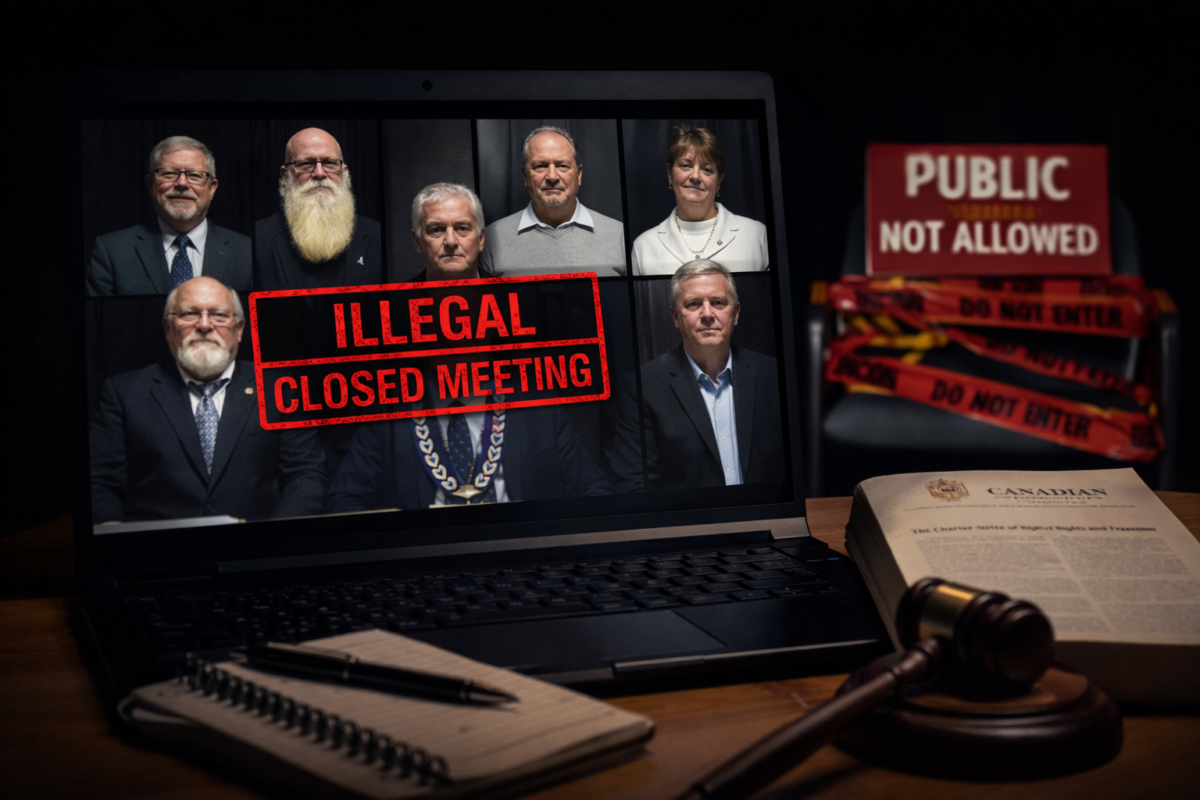
(Wingham, North Huron, ON) On March 2, 2026, the Municipality of North Huron delivered what many residents are calling the most serious blow to local democracy in over a decade.

Council meetings have now gone fully virtual.
No public gallery.
No in-person accountability.
No ability to stand, ask, and demand answers in the room where decisions are made.
And questions? Still banned.
A Manufactured Crisis

Just two weeks ago, on February 17, a councillor instigated a confrontation after a council meeting. Instead of addressing that conduct transparently, council has now used the incident as justification to remove the public entirely.
Let’s be clear:
When elected officials behave badly, the solution is accountability — not locking the public out.
Yet that is exactly what happened.
Meetings are now held virtually, eliminating the only meaningful opportunity residents had to question council before or after meetings. Under this new structure, residents cannot ask questions “before” a virtual meeting — because there is no physical presence, no access point, no forum.
The standoff between residents and council is not over. It has escalated.
The Law: Open Means Open
Under Ontario’s Municipal Act, 2001, section 239(1):
“Except as provided in this section, all meetings shall be open to the public.”
The Ontario Ombudsman’s Open Meeting Guide reinforces this principle: openness is foundational to democratic legitimacy. Closed meetings are permitted only under specific, narrow exceptions.
Security concerns must be real, documented, and proportionate.
Blanket removal of public access is not an exception listed in the Act.
Virtual Is Not a Substitute for Public Presence
During COVID-19, emergency orders temporarily allowed virtual meetings. That was an emergency measure — not a permanent replacement for democratic access.
The courts have consistently emphasized that public bodies must not use procedure to frustrate public participation.
In London (City) v. RSJ Holdings Inc., 2007 SCC 29, the Supreme Court of Canada stressed that open meeting requirements must be interpreted broadly to protect transparency.
The Ontario Ombudsman has repeatedly ruled that municipalities cannot use technicalities or procedural manoeuvres to undermine the spirit of openness.
Watching a livestream is not the same as attending.
Muting microphones is not the same as accountability.
Shutting down questions is not governance — it’s insulation.
Recording Was Never Illegal
Council quietly amended its procedural bylaw to remove language claiming that recording meetings was “illegal.”
Here’s the truth: it was never illegal in the first place.
There is no provision in Ontario law granting municipalities authority to prohibit recording of open meetings. In fact, the right to document public proceedings engages section 2(b) of the Canadian Charter of Rights and Freedoms — freedom of expression.
Multiple legal organizations, including the Canadian Civil Liberties Association, have affirmed that individuals may record public officials in public spaces so long as they are not obstructing proceedings.
North Huron’s previous ban was legally unsustainable. Its quiet removal is an implicit admission.
Ten Years of Question Suppression
For over a decade, meaningful public questioning has been restricted, filtered, or banned outright.
Now, with meetings virtual, even informal accountability moments — before and after meetings — are gone.
The only effective pressure valve left in municipal politics has been removed.
Residents cannot:
- Approach councillors after meetings
- Ask spontaneous follow-up questions
- Observe side conversations
- Witness tone, demeanor, and conduct up close
Democracy is not meant to be comfortable for elected officials. It is meant to be accessible to citizens.
Precedent Is Clear: Openness Is Mandatory
The Ontario Ombudsman has ruled repeatedly that municipalities must interpret open meeting requirements generously in favour of transparency.
In numerous reports, the Ombudsman has warned councils against procedural tactics that erode public confidence.
A meeting is not “open” merely because a video link exists.
Openness requires meaningful access.
If the public is excluded as a class, the spirit — and arguably the letter — of the Municipal Act is violated.
Democracy Has Taken a Blow
North Huron’s decision signals something larger:
When questions become inconvenient, remove the questioners.
When scrutiny intensifies, move behind a screen.
When accountability becomes uncomfortable, call it “safety.”
But democracy does not function on convenience.
It functions on visibility.
It functions on presence.
It functions when citizens can stand in the same room as the people who govern them.
The Right to Question Must Return
Council must:
- Restore in-person public access immediately
- Reinstate meaningful public question periods
- Clarify legal justification for excluding residents
- Provide written legal opinion supporting their interpretation of the Municipal Act
Virtual attendance may supplement access.
It cannot replace it.
The public gallery is not a privilege. It is a right embedded in Ontario law.
This Is Not Over
The standoff continues.
The attempt to close council chambers will not restore trust. It will erode it further.
North Huron residents deserve:
- Open doors
- Open microphones
- Open government
Until those are restored, the legitimacy of council’s decisions will remain under a cloud.
Democracy in North Huron did not quietly fade on March 2.
It was pushed out of the room.
And the public is demanding to be let back in.